
October Patch Tuesday: the flaw already under attack wasn't marked Critical.
The only flaw in the release already being used in attacks disables the warning Windows shows when you open a downloaded file. Microsoft rated it “Important”, so anyone ranking patches by that label puts it behind 70 Criticals.
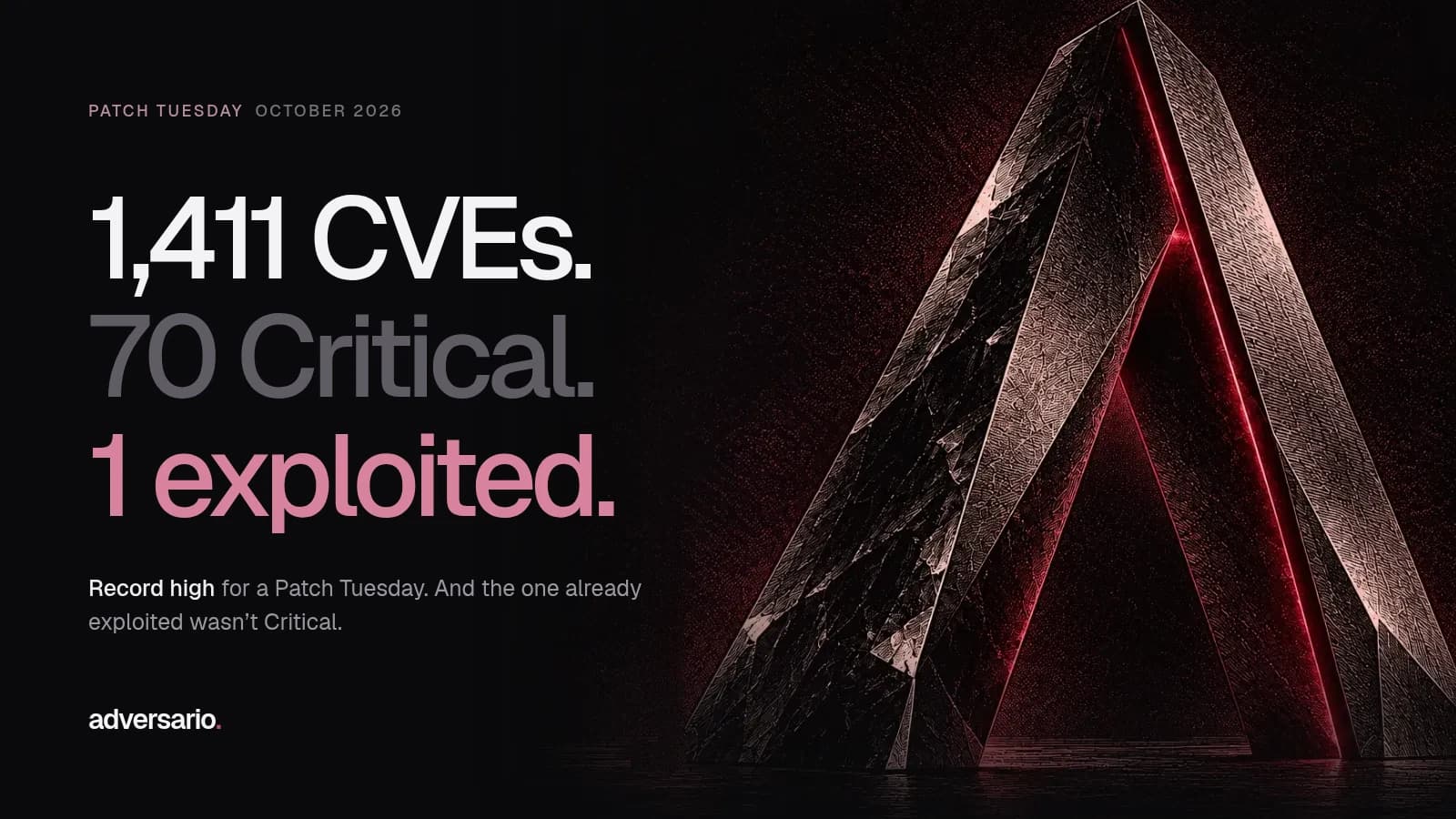
On October 13, Microsoft shipped the largest monthly release in its history: 1,411 vulnerabilities fixed, 70 of them rated Critical.
Only three of those 1,411 come with evidence that someone is already using them or could start today. CVE-2026-96951, in Windows Shell, is being exploited in real attacks. CVE-2026-108398, in .NET Framework, and CVE-2026-92707, in the MessagePack-CSharp library, went public before a patch existed. None of them is among the Criticals: the first two are rated “Important”, with a CVSS of 8.8, and the MessagePack one is “Moderate”, at 5.3.
A team that works through patches from the highest label down reaches them after the 70 Criticals, even though they are the only ones in the release with confirmed attacks or public details.
WHY THIS HAPPENS
The label doesn't change when the attacks start.
The CVSS base score and Microsoft's severity rating describe the flaw itself: how easy it is to attack and what it lets an attacker do. They are set when the release ships and don't reflect whether real attacks show up later. That signal lives elsewhere: CISA's KEV catalog, which only lists flaws with confirmed exploitation, and the public disclosure flag on each Microsoft advisory.
The label doesn't know your network either. A 9.8 remote code execution on a service nobody can reach can wait for the normal cycle. An 8.8 bypass that affects every machine receiving email can't wait.
OCTOBER 2026
What to look at first.
The first three have evidence: one exploited and two public. The other three don't, but they allow remote code execution without credentials, which makes them urgent wherever the service is exposed.
CVE-2026-96951
Windows Shell
Disables the warning Windows shows when opening a file that was downloaded or received by email (Mark of the Web). The attacker sends the file and, if the victim opens it, it runs without the security prompt. It doesn't grant access on its own, but it makes any phishing campaign more effective. Affects Windows 10, Windows 11 and Windows Server 2012 R2 through 2025.
- Type
- Security bypass
- CVSS
- 8.8
- Microsoft
- Important
- CISA KEV
- Yes · due Oct 16 ↗
BY PRODUCT
What stands out in the release
| Product | CVE | What happens | Microsoft | CVSS |
|---|---|---|---|---|
| Windows Shell | CVE-2026-96951 | Exploited · in KEV ↗ | Important | 8.8 |
| .NET Framework | CVE-2026-108398 | Public before the patch · bypasses WDAC | Important | 8.8 |
| MessagePack-CSharp | CVE-2026-92707 | Public before the patch · denial of service | Moderate | 5.3 |
| NPS · RADIUS | CVE-2026-100222 | Remote code execution, no credentials | Important | 9.8 |
| Windows MSMQ | CVE-2026-100202 | Remote code execution, no credentials | Critical | 9.8 |
| Microsoft QUIC | CVE-2026-100219 | Remote code execution, no credentials | Critical | 9.8 |
NPS is the clearest case in this piece: remote code execution without credentials, CVSS 9.8, and Microsoft rated it “Important”. None of the last three had known exploitation as of October 13. Whether they go this week or in the normal cycle depends on where they are exposed.
CISA · BOD 26-04 · JUN 10, 2026
How CISA prioritizes since June.
BOD 26-04 replaced directives 19-02 and 22-01, which set deadlines by severity or by the date a flaw entered KEV. Deadlines now come from four questions.
Exposure
Is the asset reachable from the Internet?
Exploitation
Is it in the KEV catalog, with confirmed exploitation?
Automation
Can the exploit be automated?
Impact
What does it allow if exploited? Full system control?
The shortest deadline, forensic triage included, applies to flaws that are exposed, automatable, give system control and are listed in KEV. The other tiers are 14 days, 60 days or the next system upgrade. CISA gave CVE-2026-96951 three days: it entered KEV on October 13 and is due on the 16th. The directive only binds US federal agencies, but KEV already serves as a reference in the private sector.
VERIZON · DBIR 2026
Closing is the hard part.
According to Verizon, closing a flaw on every affected asset takes longer every year, and every year there are more flaws to close.
Source: Verizon, 2026 Data Breach Investigations Report. Years refer to the period measured in the report.
BEFORE NOVEMBER 10
What to do this month.
The next Patch Tuesday lands on November 10. These four steps fit before then.
- 01
Find the three flaws with evidence.
Windows Shell (CVE-2026-96951) is on virtually every Windows machine: start with the ones that receive email and download files. The .NET flaw (CVE-2026-108398) matters wherever you rely on WDAC, the Windows control that decides which applications are allowed to run. The MessagePack-CSharp flaw (CVE-2026-92707) can only take an application down, but its details are already public: check which .NET applications use that library. If you have Windows 11 24H2 Home or Pro machines, their support ended on October 13 and they won't receive upcoming patches.
- 02
Check whether MSMQ, NPS or QUIC are reachable.
If any of them answers from the Internet or from third-party networks, it goes in the same batch as the flaws with evidence. If not, it can follow the normal cycle.
- 03
If you can't patch, contain it and log it.
Restricting who can reach the service or isolating the machine lowers the risk until the patch lands. Write down what was done and until when, so the exception doesn't get forgotten.
- 04
Verify the fix is real.
A patch showing as installed doesn't guarantee the attack no longer works: pending reboots and machines missing from the inventory are common. Before calling a flaw closed, someone should try to exploit it again.
For the board report.
More useful than the number of closed tickets: how many flaws with confirmed exploitation are still open, for how many days, and which ones were contained without a patch.
Microsoft publishes once a month, and attacks don't follow that calendar. Mandiant estimates that in 2025, on average, exploitation began seven days before a patch existed.
Microsoft sets the calendar. You set the priority.
Sources
MSRC · Security Update Guide, October 2026 ↗MSRC · CVE-2026-96951 (Windows Shell) ↗MSRC · CVE-2026-108398 (.NET Framework) ↗MSRC · CVE-2026-92707 (MessagePack-CSharp) ↗Zero Day Initiative · The October 2026 Security Update Review ↗BleepingComputer · Microsoft October 2026 Patch Tuesday fixes 1,411 flaws, 3 zero-days ↗SANS Internet Storm Center · October 2026 Microsoft Patch Tuesday ↗CISA · BOD 26-04: Prioritizing Security Updates Based on Risk ↗CISA · Known Exploited Vulnerabilities Catalog ↗Verizon · 2026 Data Breach Investigations Report ↗Mandiant · M-Trends 2026 ↗Adversario analysis based on Microsoft's Security Update Guide and the sources cited. We use BleepingComputer's count, which only includes what was released on Patch Tuesday itself: 1,411 vulnerabilities and 70 Critical. Other counts range from 1,407 to 1,417 depending on what each source includes; SANS ISC, for example, reaches 1,417 and 76 Critical because it adds cloud-service fixes that require no customer action. ZDI and BleepingComputer count three zero-days based on Microsoft's flags: one exploited flaw (CVE-2026-96951) and two publicly disclosed (CVE-2026-108398 and CVE-2026-92707).